A Slow Walk Along the Airfield Fence
A regional airfield keeps a public edge: a wire fence, a windsock, and a mile of grass. Nell walks the perimeter in May and learns to hear engines long before she sees them.
There is a kind of walk that goes nowhere and still fills an afternoon completely. Walking the fence of a regional airfield is the purest example I know of the type. You follow a perimeter you cannot cross, watch machines you will not board, and come home strangely rested.
This particular airfield sits within an easy day of Providence, at the edge of a town I reached by bus. I am not going to name it, because every regional field offers roughly the same quiet gifts. Find the one nearest you, confirm that its perimeter road welcomes walkers, and borrow my afternoon in spirit.
I went on a Wednesday in early May, when the grass inside the wire stood just past ankle height. The forecast called for a south wind at ten miles an hour, which matters more here than sunshine. Wind is the whole grammar of an airfield, and the fence is where you learn to read it.
The road to the wire
The bus left me beside a gravel shoulder, across from a seed store and a shuttered diner. From there a plain town road runs half a mile to the field, between hedgerows loud with sparrows. You know you are close when the utility poles stop and the sky widens all at once. Airfields keep their approaches clear, so the land around them feels mowed by giants.
The perimeter road begins at a chain gate marked for authorized vehicles, with a walking margin worn beside it. The surface is packed gravel, pale as oatmeal, and it crunches in a satisfying private rhythm. On my left ran the fence, galvanized chain link a head taller than me, humming faintly in the wind. On my right the town fell away into pasture, with one white water tower pinned to the horizon.
I passed two official signs in the first quarter mile, both more polite than I expected. One asked me to stay outside the wire, and the other explained the field's noise reduction hours. Somebody had wired a child's pinwheel to a fence post, and it spun with complete seriousness.
Reading the windsock
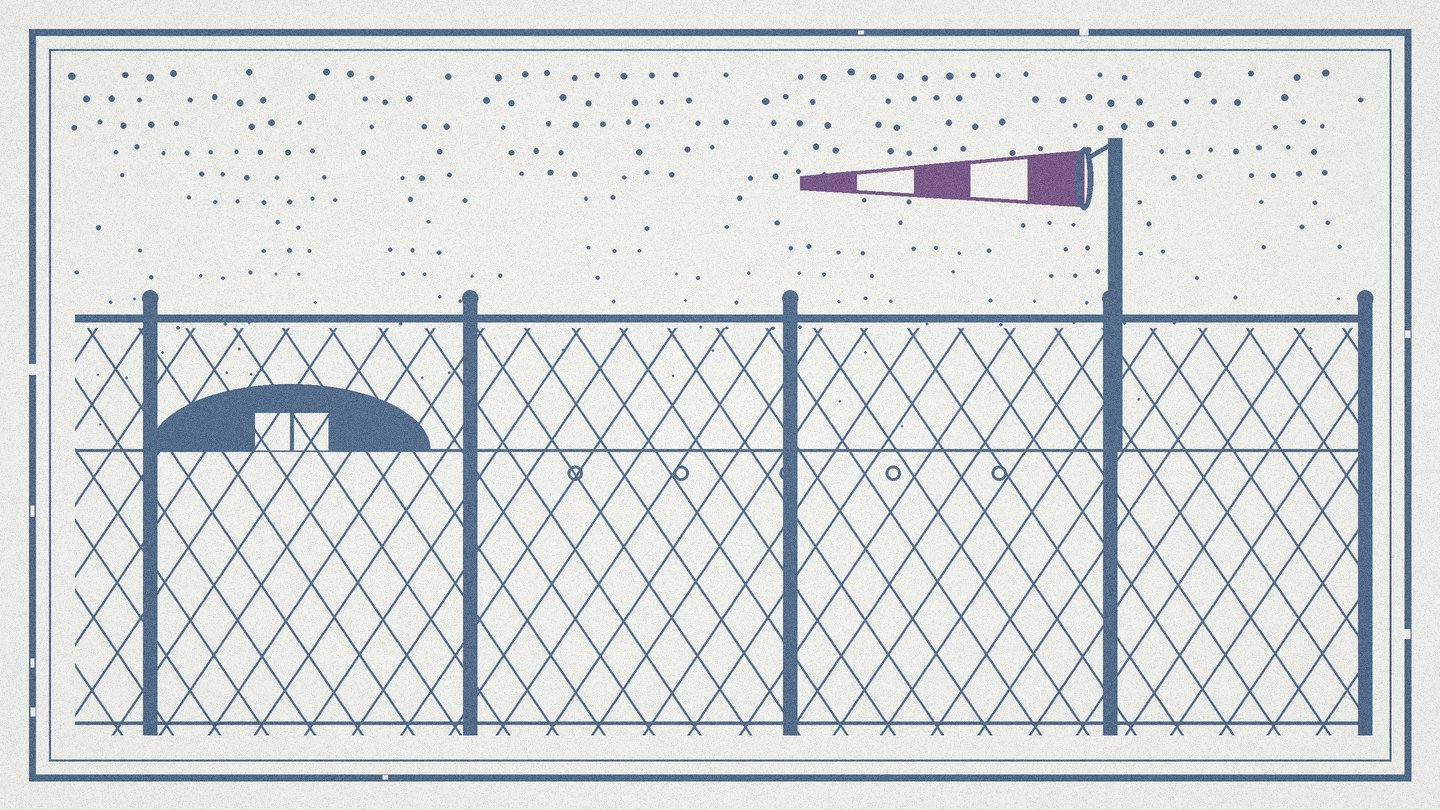
The windsock lives on a short mast near the midpoint of the field, orange against every possible sky. It is the one instrument here that publishes its findings to the general public. A limp sock means calm, a half raised sock means a working breeze, and a straight sock means hold your hat. Mine flew at about half staff all afternoon, swinging slowly between south and southwest.
Once you notice the sock, you start seeing the same news printed everywhere else. The grass inside the wire leaned in agreement, silver side up, in long combed waves. A flag over the fuel shed confirmed the direction, and the gulls all faced into it like weathervanes. Even the small planes at their tie downs seemed to strain politely toward the source.
I spent twenty minutes matching the sock against the clouds and felt time loosen its grip. There is no scoreboard at an airfield fence and no finish line either. The sock fills, the sock settles, and the afternoon keeps a rhythm older than engines.
Engines at a distance
Sound arrives at a fence walk long before anything worth photographing does. A single engine drone came out of the southwest, faint as a lawn being mowed two streets over. I counted a full minute before the plane itself appeared, a high winged speck the size of a housefly. It settled onto the grass strip, bounced once with dignity, and rolled to a modest stop.
The afternoon traffic ran to perhaps one arrival or departure every quarter hour, unhurried as a small harbor. Each engine had its own voice, some smooth as sewing machines, one coughing like a cold morning. Between them the field returned to sparrow song, wind in the wire, and my own gravel footsteps. The contrast between the two is the whole show, and it never repeats itself exactly.
Two retirees had set folding chairs at the fence corner, with a thermos balanced on the post between them. They waved me over and narrated the pattern for me, touch and go, crosswind, final. I understood roughly one word in five and still enjoyed every single one of them. You do not need the vocabulary here, because the plot explains itself in slow circles.
The nations of the verge
A fence line is an edge habitat, and edges are where the living traffic concentrates. The mowed strip held clover, violets, and the first dandelion clocks of the season. Sparrows ran customs inspections along the bottom rail, and a kestrel worked the field side like a patrol. Every fifty steps something small burst out of the grass, ran ten feet, and forgot why.
I have walked prettier paths this spring, but none with a busier border. The wire divides two worlds that ignore the division completely, which is a quiet joke you get to be in on. Seeds, birds, and engine noise all cross the line without showing any papers. Only walkers respect the boundary, and we get the show in exchange for our manners.
The long side home
Past the corner the fence runs a straight half mile with nothing to lean on and no shade at all. In May that is a pleasure, with the grass seeding and swallows working low over it. By July I suspect this stretch bakes, so carry water and a brim if you come in summer. The gravel gives way to mowed verge here, softer underfoot and loud with crickets by late season.
I turned back at the far gate, where the perimeter road bends toward hangars and stops being a stroll. The return leg took forty minutes at a deliberate pace, with the wind now pushing at my back. The windsock saw me off at half staff, still steady, still orange, still entirely sure of itself. The whole visit, gate to gate and back again, came to just over three miles.
Worth the walk
An airfield fence walk suits people who like their spectacle rationed and their horizons wide. It will not suit anyone who needs shade, benches, or a payoff you can hold. The gravel runs loose in places, so strollers roll hard there and thin soles complain. Engine noise stays distant but real, and soft ear covers for a small child are not a silly idea.
Go on a breezy weekday, pack your own water, and give the sock the attention it quietly asks for. Stay outside the wire, leave the gates alone, and wave back when a pilot waves first. I walked home past the seed store lighter than I arrived, which is the only measurement I trust.
Mile notes
- Perimeter road access and public viewing customs are noted on the host town's municipal pages.
- Windsock reading basics come from general aviation handbooks shelved in public library collections.
- Field hours and noise reduction notes are posted on the public board beside the airfield's south gate.

Nell Harrow, founder and editor. Walks out of Providence, writes on the way back.
Connecting routes
- JunctionsThe Long Way Over the River Bridge
- JunctionsThe Last Train Back
- CircuitsOut to the Harbor Light and Home Again